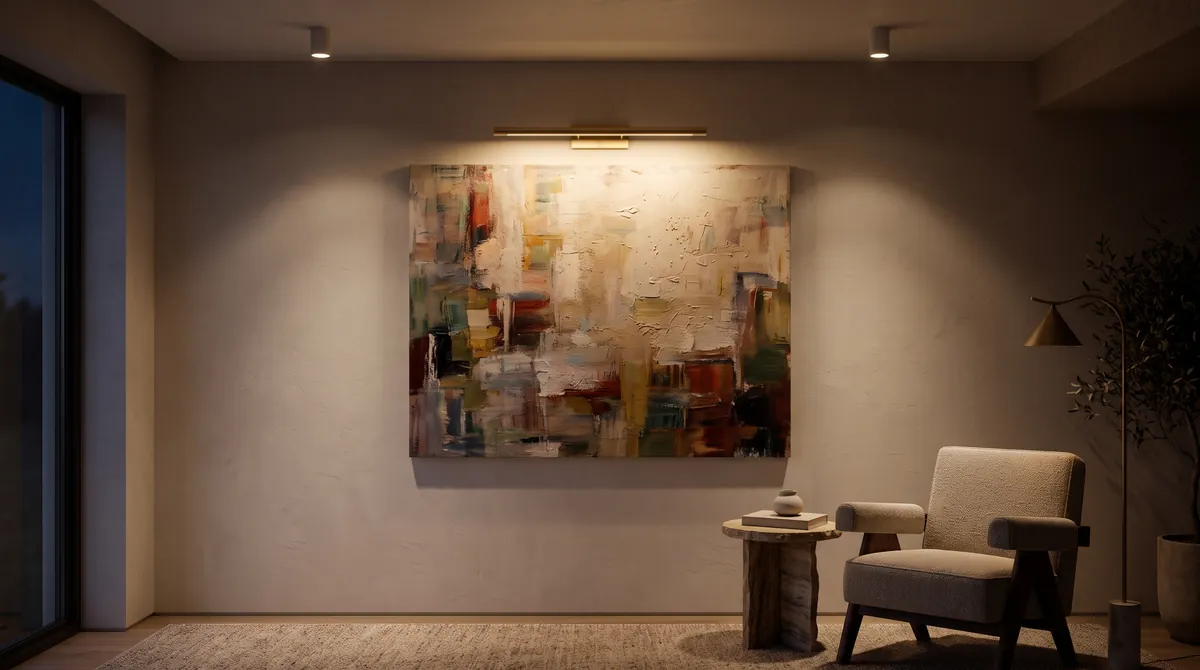

Lighting art at home, warm, safe and without glare
How to choose colour temperature, beam angles and fittings so that paintings, prints and sculpture look their best at home, without fading or glare.
Light is half of every artwork. The same painting can look flat and grey under a single ceiling bulb and suddenly deep and glowing under a well aimed spot. At home you do not need a museum’s lighting budget to get close to museum results. You need the right colour of light, the right angle and a few habits that protect the work while it is on show.
Colour temperature and colour rendering
Light sources are described by their , measured in kelvin (K). Lower numbers look warmer and more golden, higher numbers cooler and bluer. For most homes, warm white of about 2700 to 3000 K feels natural in the evening and flatters older paintings, gilded frames and warm wood tones.
Neutral white of about 3000 to 4000 K suits contemporary work, photography, cool palettes and rooms that get a lot of daylight. Many galleries settle on around 3000 K as a balanced middle. Whatever you choose, keep it consistent along one wall, because mixing warm and cool lamps makes art look patchy.
Just as important is the , or CRI, a score up to 100 that describes how faithfully a light source shows colours compared with a reference light. Ordinary household lamps often sit at around 80 or below. For art, look for LEDs with a CRI of 90 or more, which keep reds, skin tones and subtle greys from turning muddy.

The 30 degree rule and how to avoid glare
Glare happens when light bounces off glass or glossy varnish straight into your eyes. Lighting designers often use an angle of about 30 degrees from the vertical, measured at the centre of the artwork, as a starting point. At that angle, reflections are sent down towards the floor rather than towards the viewer, and the frame casts only a short shadow.
A steeper angle, with the light close to the wall, makes deep frames throw long shadows across the top of the picture. A shallower angle, with the light further out in the room, raises the risk of reflections and of light shining into the eyes of people seated opposite. Raking light across a textured painting shows every brushstroke, which can be beautiful, but it also exaggerates cracks.
In a room with a ceiling height of about 2.5 to 3 metres and a picture centred at normal eye level, the 30 degree rule places a ceiling spot roughly 60 to 90 cm (about 2 to 3 feet) out from the wall. Treat this as a first position and fine tune it by eye.
Spots, track and picture lights
Recessed ceiling spots with adjustable heads are discreet and suit a fixed hang. Match the to the work: a narrow beam for a small picture, a wider one for a large canvas or a whole group. A beam that is too wide simply lights the wall around the picture.
is the flexible option. Spots clip into a rail on the ceiling and can be moved, added or re-aimed whenever the hang changes, which is why so many galleries rely on it. For anyone who rotates a collection, it is the most practical choice.
Picture lights, the slim arms fixed above or onto a frame, give a traditional, intimate look in libraries and studies. Older models with incandescent bulbs sat close to the canvas and added heat. Modern LED versions run far cooler, but they still light the top of a work more strongly than the bottom, so they suit small and medium sized pictures best.
Dimmers are worth adding to every circuit that lights art. They let you set a gentle level for evenings, reduce exposure when nobody is in the room and balance the art against the rest of the lighting.
Protecting what you light
All light causes some damage, and the effect adds up and cannot be reversed. Ultraviolet radiation is the most harmful part, and infrared adds heat. Good LEDs emit very little ultraviolet and far less heat than halogen or incandescent lamps, one reason museums have widely adopted them, but visible light still fades sensitive materials over time.
Museums commonly limit works on paper, watercolours, textiles and photographs to around 50 , while oil and acrylic paintings are often shown at around 150 to 200 lux. You do not need a light meter at home, but the principle is useful: keep drawings, prints and photographs in softer light and away from windows, and save stronger spots for paintings.
- Never hang works on paper where direct sunlight reaches them, even for an hour a day.
- Choose UV filtering glazing for prints, drawings and photographs.
- Dim or switch off art lighting when nobody is in the room.
- Rotate the most sensitive works so each spends time resting in a folder or drawer.
- Keep any halogen or incandescent lamp well away from canvases and frames.
The right angle matters as much as the right lamp.
Room by room
In the living room, light the main work with one or two adjustable spots or a short track, and keep the rest of the room in softer, warmer light so that the art becomes the focus in the evening. In a hallway, where people pass rather than pause, an even wash from a row of spots turns a series of pictures into a small gallery.
In the dining room, make sure lights over the table do not strike glazed pictures at a low angle, or seated guests will see reflections. In a bedroom, a dimmable picture light gives a calm glow. For sculpture, light from one side and slightly above, with softer light from the other side, so the shadows describe its volume. Light from straight in front flattens any form.
Terms in this article
- Colour temperature
- A measure of whether light looks warm or cool, given in kelvin; lower values look warmer and more golden.
- Colour rendering index
- A score up to 100 describing how faithfully a light source shows colours; 90 or more is recommended for art.
- Lux
- The unit of illuminance, the amount of light falling on a surface, used by museums to set safe light levels.
- Beam angle
- The width of the cone of light from a lamp; narrow beams suit small works, wide beams larger ones.
- Track lighting
- Spotlights mounted on a ceiling rail that can be moved, added and re-aimed as a display changes.
Readers ask
Can LED light damage paintings?
LEDs designed for display emit very little ultraviolet and much less heat than halogen or incandescent lamps, so they are among the safest choices for art. Any visible light still causes slow, cumulative fading in sensitive materials, however. Keep works on paper in softer light, use dimmers, switch the lights off when nobody is there and never let direct sunlight fall on the work.
Are picture lights a good idea?
Modern LED picture lights work well for small and medium sized paintings, especially in traditional rooms. They run cool and are easy to fit. Because they sit close to the top of the frame, they light the upper part of a work more strongly than the lower part, so for large canvases a ceiling spot or track light at about 30 degrees usually gives more even light.
What is CRI and why does it matter?
CRI stands for colour rendering index, a score up to 100 that shows how faithfully a light source reproduces colours. Many household lamps score around 80 or below, which can make reds dull and skin tones flat. For art, a CRI of 90 or more is widely recommended, so the colours you see at home stay close to the ones the artist intended.


