
Andy Warhol, soup cans, silkscreens and fame as material
Andy Warhol took soup cans, film stars and newspaper photographs and made them into art. His questions about fame, repetition and brands have never gone away.
Andy Warhol1928 to 1987 · PittsburghPop Art
Andy Warhol made the ordinary look strange and the famous look ordinary. Soup cans, dollar bills, film stars and car crashes all passed through his studio and came out as art. More than any other artist of his time, he understood how images travel in a world of advertising, television and celebrity. Here is how he worked, and where to see the results.
From Pittsburgh to the New York magazines
Andrew Warhola was born on 6 August 1928 in Pittsburgh, Pennsylvania, the son of working-class Rusyn immigrants from a village in what is now Slovakia. He studied pictorial design at the Carnegie Institute of Technology, graduated in 1949 and moved to New York the same year.
Through the 1950s he was one of the city’s most successful commercial illustrators, drawing shoes, fashion and advertisements for magazines and stores. He perfected a technique, pressing a wet ink drawing onto another sheet to produce a slightly broken, printed look. It was an early sign of his taste for images that seem made by a process rather than by a hand.
Soup cans and the arrival of Pop Art
Around 1960 Warhol turned to painting, taking his subjects from comics and advertising. , which emerged in Britain and the United States, drew its imagery from consumer goods and mass media. In July 1962 Warhol showed Campbell’s Soup Cans in Los Angeles: 32 canvases, each 51 by 41 cm (20 by 16 inches), one for every variety of soup the company then sold.
Surprisingly, these canvases were painted by hand, not printed, though they look machine-made. The point was sameness: the same can and the same label, varied only by the name of the flavour. Since 1996 the whole set has belonged to the Museum of Modern Art in New York, which usually shows it as a grid.
How a silkscreen works
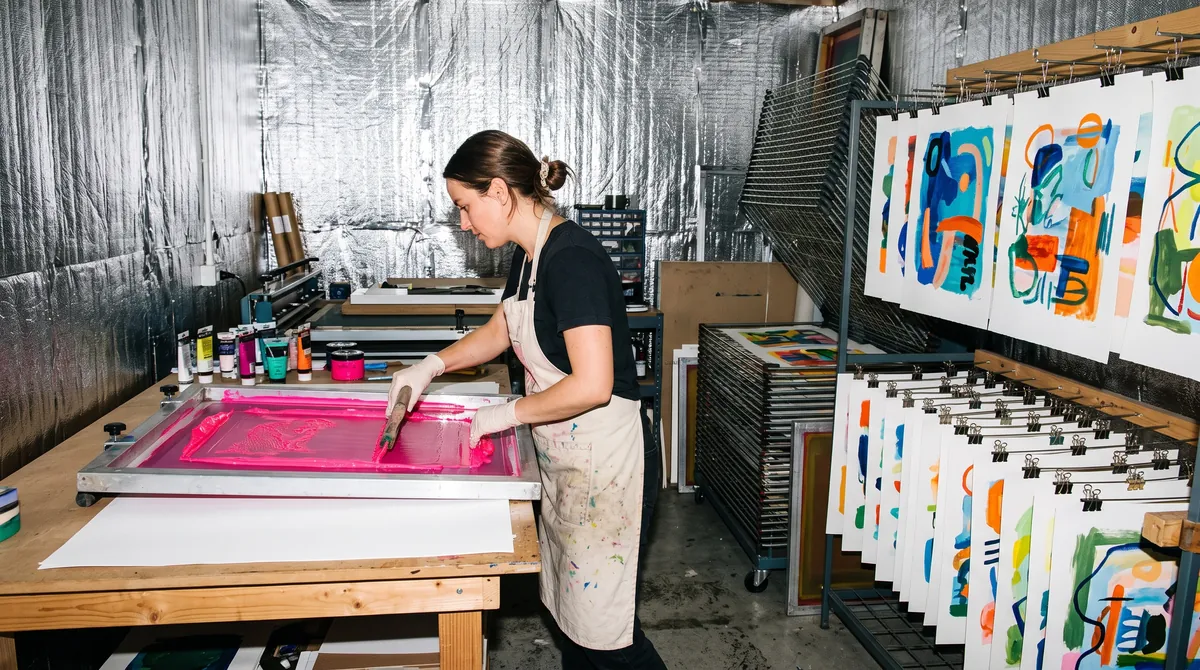
Later in 1962 Warhol began to use photographic , the method behind his best-known work. Silkscreen, also called screenprinting, is a stencil technique: a fine mesh is stretched on a frame and partly blocked, so that ink passes through only where the image should appear. In outline, the process runs like this.
- A photograph, often from a newspaper or a publicity still, is chosen and enlarged onto clear film.
- The screen is coated with a light-sensitive emulsion and exposed through the film, so the emulsion hardens everywhere light reaches it.
- The unhardened emulsion behind the dark parts of the image is washed out, leaving open mesh.
- Areas of flat colour, such as a face, lips or eyeshadow, are often painted onto the canvas first.
- The screen is laid on the canvas and ink is pulled across it with a rubber blade called a , printing the black image on top.
Warhol welcomed the accidents of the process: uneven pressure, smudges and colours that slip out of register, meaning out of alignment with the printed image. After the death of Marilyn Monroe in August 1962 he repeated her publicity photograph again and again. Marilyn Diptych (1962), now at Tate in London, sets fifty images of her face across two panels, bright colours on the left and black and white on the right, where they grow faint and smeared.
The Shot Marilyns followed in 1964. One of them, Shot Sage Blue Marilyn, sold at Christie’s in New York in 2022 for 195 million US dollars, a record at auction for a work by an American artist.
The Factory, films and a year of violence
In the mid 1960s Warhol worked in a studio on East 47th Street that became known as the Factory. Its walls were covered in silver foil and paint, and it filled with assistants, musicians, actors and visitors. There he produced paintings in series, sculptures such as the Brillo Boxes of 1964 and hundreds of films, from the hours-long Sleep and Empire to Chelsea Girls (1966). He also managed and promoted the rock band The Velvet Underground.
On 3 June 1968 Warhol was shot at his studio by Valerie Solanas, a writer who had appeared in one of his films. He was critically wounded, survived after emergency surgery and lived with the physical effects for the rest of his life.
- 1928Born Andrew Warhola in Pittsburgh on 6 August.
- 1949Graduates from the Carnegie Institute of Technology and moves to New York.
- 1962Shows Campbell’s Soup Cans in Los Angeles and begins working with silkscreen.
- 1964Shows his Brillo Boxes in New York.
- 1968Survives being shot at his studio on 3 June.
- 1969Co-founds Interview magazine.
- 1987Dies in New York on 22 February, aged 58.
- 1994The Andy Warhol Museum opens in Pittsburgh.
Fame, business and the later years
In 1969 Warhol co-founded Interview, a magazine built around conversations with celebrities. Through the 1970s and 1980s he made commissioned portraits of collectors, socialites, musicians and politicians, often from Polaroid photographs, and series such as Mao (1972). In the mid 1980s he collaborated on paintings with the younger artist Jean-Michel Basquiat.
Warhol died in New York on 22 February 1987, aged 58, after complications following gallbladder surgery. His will provided for the Andy Warhol Foundation for the Visual Arts, which has supported artists and art institutions ever since.
Where to see Warhol and why he still matters
The Andy Warhol Museum in Pittsburgh, opened in 1994 on the city’s North Shore, is the largest museum in North America devoted to a single artist. Across seven floors it shows paintings, drawings, prints, films and the Time Capsules, hundreds of cardboard boxes that Warhol filled with letters, receipts, gifts and everyday objects. MoMA in New York, Tate in London and most major museums of modern art also hold important works.
His ideas are everywhere now. Brands borrow the look of art, artists borrow the language of brands, and repeating an image until it feels familiar is the basic logic of social media. Warhol did not invent celebrity culture, but he treated fame as a material, like paint or film, and made us look at how it is manufactured.
He treated fame as a material, like paint or film, and made us look at how it is manufactured.
Terms in this article
- Pop Art
- Movement of the late 1950s and 1960s, mainly in Britain and the United States, that used imagery from advertising, comics and consumer goods.
- Silkscreen
- A stencil printing method in which ink is pressed through a fine mesh onto paper or canvas; also called screenprinting.
- Blotted line
- Warhol’s illustration technique of pressing a wet ink drawing onto another sheet to create a broken, printed-looking line.
- Squeegee
- A rubber blade on a handle used to pull ink across a screen in screenprinting.
Readers ask
Did Warhol make all his works himself?
Not alone. From the 1960s he worked with assistants at the Factory, who helped prepare screens, mix colours and print canvases under his direction. Warhol chose the images, colours and formats and decided what was finished. This way of working was part of his idea: art could be produced like other goods, yet his choices still shape every picture.
What is the difference between a Warhol painting and a Warhol print?
His paintings are unique canvases, usually combining hand-painted colour with silkscreened ink. His prints are editions on paper, made in a set number of impressions, often numbered and signed. Both use the same screenprinting technique, but they differ in support, scale and rarity. For prints, the edition details and the publisher matter, and the Edition Decoder explains the usual notations.


