
Johannes Vermeer, the quiet light of Delft
Barely three dozen paintings, most of them small, almost all set in a few quiet rooms. How Vermeer turned window light, ultramarine and patience into some of the most loved pictures in art.
Johannes Vermeer1632 to 1675 · DelftDutch Golden Age
A woman pours milk. A girl turns her head towards us. Light falls through a window on the left and settles on a whitewashed wall. Johannes Vermeer painted very little, and almost nothing happens in his pictures, yet people cross continents to stand in front of them. This is a painter who rewards slow, close looking more than almost any other.
A life in Delft
Vermeer was baptised in Delft in 1632 and spent his whole life there. His father was a silk weaver who also dealt in paintings and ran an inn, and Vermeer seems to have continued the picture dealing alongside his own work. In 1653 he married Catharina Bolnes and registered as a master painter with the local , the professional body of painters, which he later led.
The couple lived with Catharina’s mother, Maria Thins, and raised a large family. Vermeer worked slowly, probably completing only a few paintings a year, and seems to have relied on a small circle of local buyers. In 1672, war and economic crisis struck the Dutch Republic and the art market collapsed. He died in Delft in December 1675, leaving his family deep in debt.
- 1632Baptised in Delft in October.
- 1653Marries Catharina Bolnes and joins the Guild of St Luke.
- 1662Elected to lead the Delft Guild of St Luke.
- 1672War and economic crisis hit the Dutch art market.
- 1675Dies in Delft in December, leaving large debts.
- 1866Théophile Thoré-Bürger’s articles revive his reputation.
- 2023The Rijksmuseum shows 28 of his paintings in a record exhibition.

Window light and a costly blue
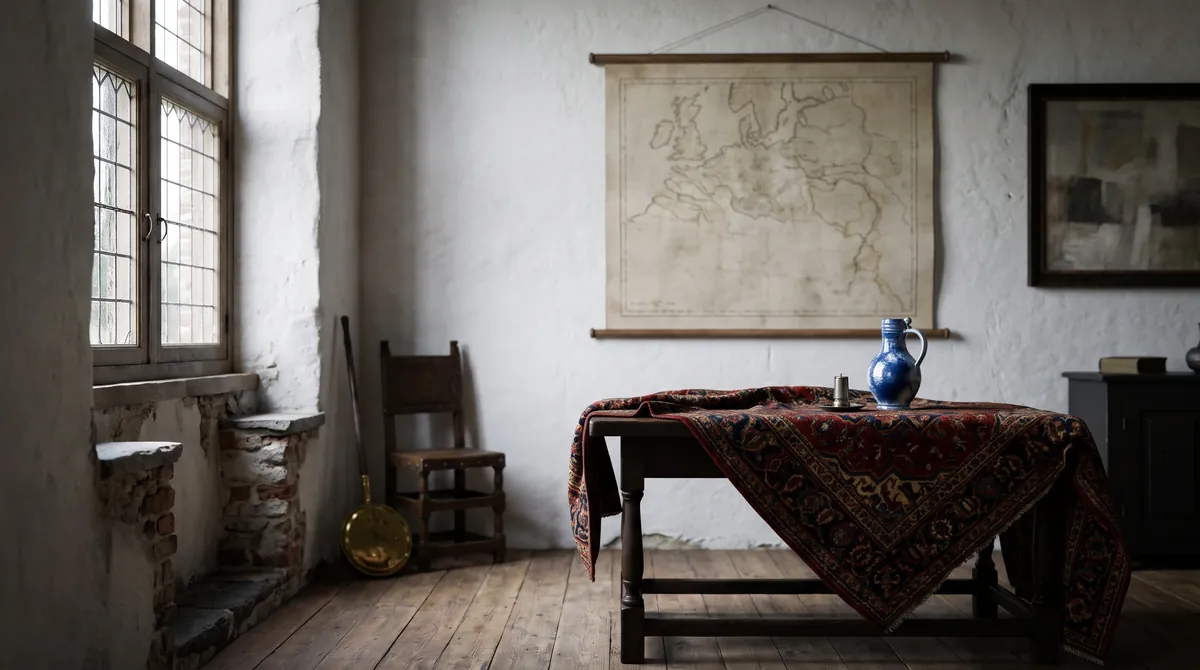
Most of Vermeer’s interiors share the same arrangement: a room seen from inside, a window on the left, and daylight falling across a figure busy with a quiet task, reading a letter, weighing on a balance, playing an instrument. He painted that light with astonishing care, down to small dots of bright paint that make bread crusts and brass glitter.
He was also generous with one of the most expensive pigments of his time. Natural was made by grinding , a semi-precious stone mined in what is now Afghanistan, and it cost far more than other blues. Vermeer used it not only for skirts and turbans but also mixed into shadows and walls, where it cools and deepens the light.
How did he achieve such optical precision? Some researchers believe he used a , a darkened box or room with a lens that projects an image onto a surface. Others point out that no document proves it and that his paintings are full of deliberate adjustments to what any lens would show. The question remains open, and it is best treated as a debate rather than a solved mystery.
The paintings and where they are now
Between 34 and 37 paintings are attributed to Vermeer today, depending on which scholars you follow. They are spread across museums in Europe and the United States, and some are rarely lent. One, The Concert, was stolen from the Isabella Stewart Gardner Museum in Boston in 1990 and has never been recovered.
Girl with a Pearl Earring is not a portrait of a known sitter but a , a Dutch term for a study of a face, often in exotic costume. That is why no one knows who she was, and why she has inspired so many stories. View of Delft, in the same museum, is one of only two townscapes he is known to have painted. The other is The Little Street in the Rijksmuseum.
Forgotten and found again
After his death Vermeer’s name faded. His paintings changed hands, sometimes under the names of other artists, and for almost two centuries he was known to only a few connoisseurs. The turning point came in 1866, when the French critic Théophile Thoré, writing as W. Bürger, published a series of articles in the Gazette des Beaux-Arts that gathered his works together and celebrated him as a lost master.
Interest has grown ever since. In 2023 the Rijksmuseum in Amsterdam brought together 28 of his paintings in the largest Vermeer exhibition ever held. With around 650,000 visitors it became the most visited exhibition in the museum’s history.
Research keeps changing how we see him, too. In Dresden, conservators working on Girl Reading a Letter at an Open Window removed later overpaint that had hidden a large picture of Cupid on the back wall, and the restored painting went back on show in 2021, noticeably different from the version visitors had known for generations.
This is a painter who rewards slow, close looking more than almost any other.
How to look at a small Vermeer
Most Vermeers are surprisingly small. The Milkmaid measures 45.5 by 41 cm (about 18 by 16 inches), and in a busy gallery it can feel smaller still. Give yourself time and use it well.
- Stand back first and take in the whole room: where the window is, where the light lands and where it fades.
- Move closer and follow one surface for a full minute, a wall, a sleeve, a piece of bread.
- Look for the tiny dots of light Vermeer placed on metal, bread and fabric.
- Notice what is left out: clutter, drama, story. Ask yourself what the figure is thinking.
- Step back again and watch the details settle into one calm image.
The Slow Looking exercise on the arisano homepage follows the same principle, if you would like to practise before your museum visit.
Terms in this article
- Tronie
- A Dutch term for a painted study of a face or character type, often in costume, rather than a portrait of a named sitter.
- Ultramarine
- A deep blue pigment, originally made from ground lapis lazuli and for centuries one of the most expensive colours in painting.
- Lapis lazuli
- A deep blue semi-precious stone, historically mined in what is now Afghanistan, ground to make natural ultramarine.
- Camera obscura
- A darkened box or room in which a lens or small opening projects an image of the outside world onto a surface.
- Guild of St Luke
- The professional association of painters and related crafts in many Dutch and Flemish towns, which controlled who could sell art.
Readers ask
How many paintings did Vermeer make?
Between 34 and 37 paintings are attributed to him today, depending on which scholars you follow. He probably painted more, since some works are mentioned in old documents but have never been identified. Even so, his output was small, which is one reason every Vermeer exhibition is such an event and why a few of his paintings rarely travel.
Did Vermeer use a camera obscura?
Nobody knows for certain. Some researchers point to optical effects in his paintings, such as soft highlights and unusual perspective, as signs that he studied images projected by a lens. Others stress that no document confirms it and that he freely rearranged what he saw. The most honest answer is that it remains a debate.
Who was the Girl with a Pearl Earring?
We do not know. The painting is a tronie, a Dutch type of picture that shows a face or character, often in exotic costume, rather than a portrait of a particular person commissioned by the sitter. That open question has inspired novels and a film, but none of the stories about her identity rests on documentary evidence.


